

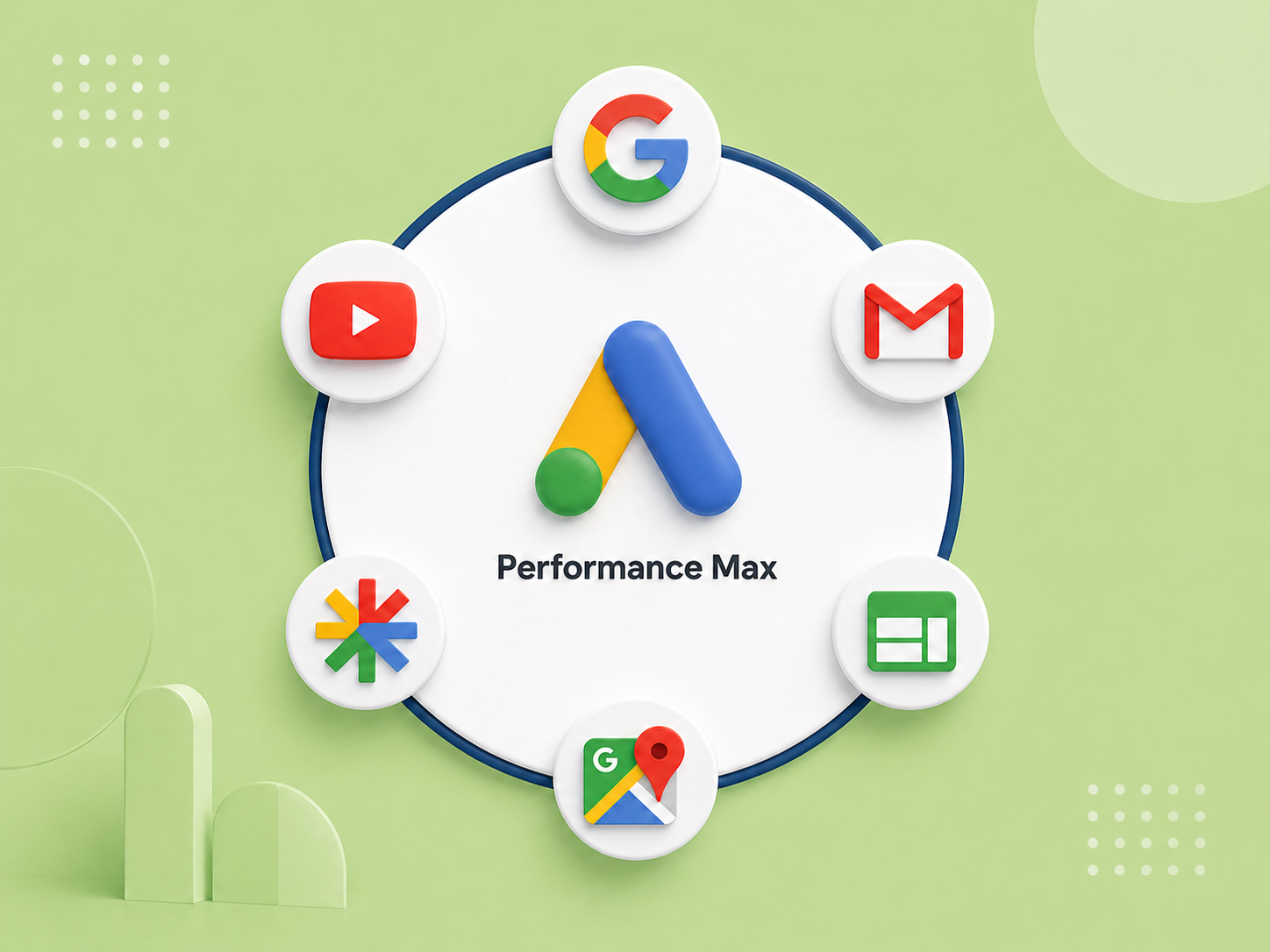
Performance Max (PMax) is Google’s AI-driven campaign type that serves ads simultaneously across Search, YouTube, Display, Gmail, Maps, and Discover from a single campaign.
You provide the budget, the conversion goals, and your creative assets. Google’s machine learning then decides which combinations to serve, to which audiences, and when. The quality of what you put in directly determines the quality of what comes out.
That last point is more important than it first appears. PMax is not a set-and-forget system. It is an AI that optimises toward the goal you set, using the creative palette you give it. Thin inputs produce thin results.
A weapon for the super niche.
For brands that operate in markets with unique terms, this is an interesting channel. For example, those whose services integrate with industrial control panels or operate within SCADA architecture, targeting can rely on the use of this exact phrase. The targeting needs to look for uses of this ridiculously niche phrase to find those in the market.
It also means you’re being served in channels where specific buying behaviour happens. Again, for example, these buyers, typically engineers, OT managers and systems integrators, are among the most research-intensive purchasers in any market. A well-produced explainer showing how your solution sits within a control architecture will do more in 90 seconds than a month of display impressions.
This is where video and brand control work together. Video creative that uses the right technical language, such as SCADA terminology, control architecture, integration workflows, adds another layer of filtering: it self-selects for the right viewer even before your exclusion settings kick in.
Video does not just help PMax, it steers it.
This is the framing shift that most B2B marketers miss. Video is not simply another asset type to add to the mix for better reach. It is one of the primary levers you have for influencing how PMax’s AI allocates budget and attention across Google’s network.
When you include strong video assets, you are actively directing the algorithm toward YouTube, one of the highest-intent research environments in B2B, rather than leaving it to default toward cheaper, lower-quality placements. You are giving the AI better signals to work with, which means it makes better decisions on your behalf.
Google’s own data makes this concrete. Campaigns that include at least one video asset see an average 12% conversion uplift compared to those running without (Google, February 2024). More video variety gives the algorithm more to optimise with, and more control sits with you, not with Google’s defaults.
It will also not manipulate your video – you remain in control of how your advert is displayed.
Most B2B marketers running PMax without video are not just leaving performance on the table. They are ceding control of an AI system to whatever defaults Google chooses. Video is the most direct way to take that control back: it directs budget toward higher-intent placements, gives the algorithm better creative signals to work with, and produces measurably better conversion outcomes.
For specialist brands in technical sectors, it also becomes the clearest expression of your credibility to an audience that trusts proof over promises. Use it deliberately, or watch a competitor use it instead.