

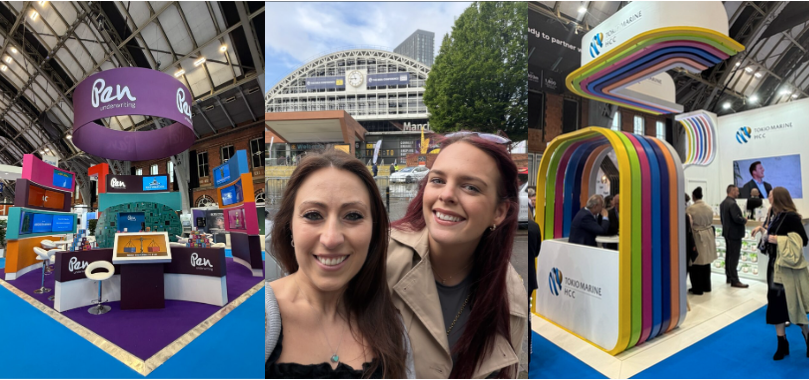
B2B exhibitions are becoming increasingly important and increasingly central to how specialist markets connect.
We know because we’ve been there. Across 2026, Velo has participated in the major exhibitions that matter to our sectors, including Utility Week Live, MACH, Fire Safety Expo, The Health & Safety Event, The Workplace Event, BIBA and more.
These are not fringe moments in the marketing calendar. For many businesses in manufacturing, professional services, technology, insurance, workplace, safety, utilities and the built environment, they are where customers, partners, prospects, competitors and internal teams come together at once. The halls are busy. The stands are polished. The conversations are valuable, but they are also different.
Buyers now arrive with intent
Buyers arrive better informed. Sales teams arrive with named accounts in mind. Customers expect time with people who already understand their world. The best conversations are often the ones planned before the doors even open.
That reflects the way B2B buying has changed. McKinsey’s 2024 B2B Pulse research found that B2B customers now use an average of ten interaction channels across the buying journey, up from five in 2016. It also found that customer preferences split roughly three ways across in-person, remote and digital self-service interactions.
So exhibitions are not isolated marketing moments. They are high-value moments inside a much bigger buying journey. That’s why they matter more than ever.
The old exhibition playbook is under pressure
The tension is that many exhibition strategies still look like they were built for a different era. Attract the crowd. Scan the badge. Hand out the giveaway. Count the leads. Declare success.
But the “day tripper” culture has declined. Fewer people are wandering halls simply to collect brochures and branded pens. More are attending with purpose.
Freeman’s 2024 Attendee Intent and Behaviour report found that 80% of respondents see in-person events as the most trusted marketing channel, while 87% said discovering new products, solutions and partners was the top factor influencing attendance. It also reported that 92% expected to attend more in-person events than the previous year.
That points to intentional attendance. Intentional audiences need a different kind of exhibition strategy.
Here are my 5 key observations from the exhibitions we’ve attended so far this year:
1. Stands are becoming meeting rooms
Exhibition stands are now meeting rooms as much as shop windows. The highest-value conversations happen with people who already know who you are. Customers. Partners. Prospects already moving through a buying journey. Channel teams. Senior stakeholders.
That means the stand has to do more than attract passing traffic. It needs to create the conditions for useful commercial conversations: places to sit, space to demo, content that helps explain value, senior people available at the right times and follow-up planned before the show begins. Footfall still matters. But footfall without purposeful conversation is just traffic.
2. Conversation quality now matters more than quantity
The second shift is that conversation quality has overtaken conversation quantity.
One well-prepared 30-minute meeting with an existing customer can be worth more than 30 cold badge scans from people with no budget, no authority and no live need. That is uncomfortable because badge scans are easy to count. Conversation quality is harder to prove. Easy measurement is not the same as meaningful measurement.
3. Events are now part of the working week
A B2B exhibition used to feel like a day out of the office. Now they are still in the office even when they are in the hall – look about, people hide in corners to join Teams calls and answer emails on the move. BIBA even had a ‘working zone’ in the centre of the exhibition hall to facilitate this.
That changes the rhythm of the event. Attention is not spread evenly across three full days. In many shows, the most valuable windows concentrate around late morning to early afternoon on day one, then the morning of day two.
Prioritise meetings into the strongest windows. Use quieter periods for customer content, partner catch-ups, internal alignment or live market intelligence.
4. Experience needs to support the relationship
Experiential stand design still matters. It creates energy, attracts attention and gives people something to remember. But in B2B, experience should not be spectacle for spectacle’s sake. It should support the relationship.
A strong experience helps explain a complex proposition, demonstrate innovation, create a useful talk track, break the ice with a prospect or give a buyer something memorable to take back to the wider buying group. That is especially important in technical, regulated or specification-led markets, where buyers need clarity, reassurance and proof.
5. Lead volume is too narrow a measure
If exhibitions are now confidence-building moments, measuring them purely on leads is outdated. TrustRadius’ 2024 B2B Buying Disconnect research found that 78% of buyers creating shortlists selected products they had heard of before starting research, rising to 86% for enterprise buyers. In that context, exhibitions are not just lead generation channels. They are brand preference channels, trust-building channels, sales enablement channels and customer experience channels.
A better scorecard should include priority account meetings held, customer relationships strengthened, opportunities accelerated, partners engaged, buying group members reached, product feedback captured, customer advocacy opportunities identified, sales team confidence improved and post-event engagement.
Design for conversations that count
B2B exhibitions have evolved because B2B buying has evolved. They are increasingly important and increasingly well attended, not because people want more noise, more giveaways or more generic sales conversations, but because specialist B2B markets still run on trust.
And trust is built faster when people can see, hear, question, compare and connect in person.
Footfall still matters. Leads still matter. Brand presence still matters.
But they are not the whole story.
The brands that win will be the ones that stop designing only for passing traffic and start designing for conversations that count.