


Everyone is talking about AI. Far fewer are talking about how they’re actually using it.
Yet most senior B2B marketers are facing the same challenge: how do you do more with less, without compromising quality, creativity or results?
We’ve reached the point where the conversation shouldn’t be about which AI tool to use. Some organisations are restricted to a single platform, while others have access to a broader mix of tools. Either way, the real differentiator is not the technology itself, but how it’s applied, governed and connected.
So rather than adding another opinion piece to the pile, we’re pulling back the curtain on how we use AI across our own marketing, and how we’re helping clients build approaches that actually work.
We built an ecosystem, not a toolkit
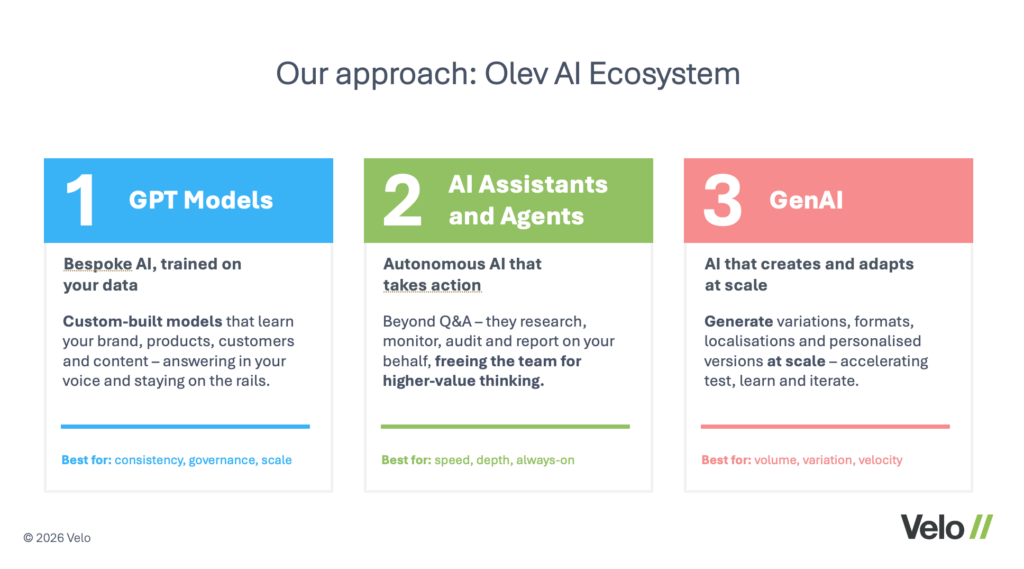
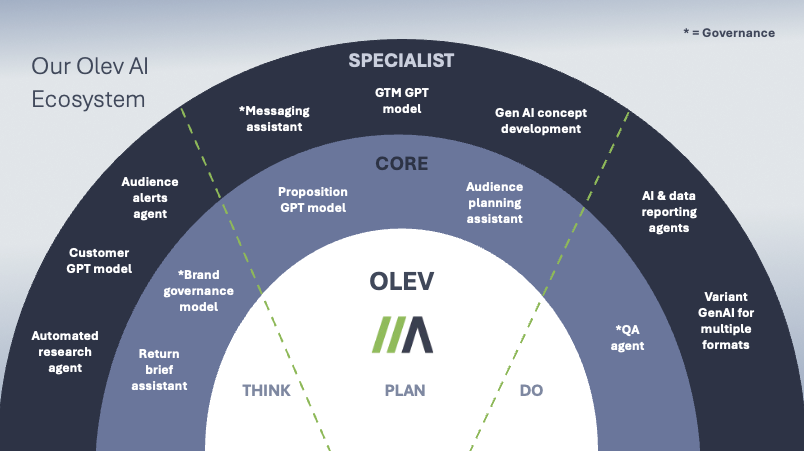
There is a critical distinction between using AI tools and building an AI ecosystem. Tools are isolated. An ecosystem is connected, governed and purposeful, and it changes what is possible. Our approach combines three layers, working in concert. At the centre of all of it is a human in the loop with the right level of experience to orchestrate the moving parts.
You’ll notice that we use many different tools in here. Eggs in one basket? No thanks. We regularly move between tools as they evolve.
One thing we’ve learnt quickly is that random use of AI only gets you so far. Better prompting helps, but prompts are only part of the equation.
The bigger challenge is knowing which tool to use for which task, what context it needs, what frameworks it should work from, and how to ensure outputs reflect the standards, expertise and thinking you’d apply yourself.
That’s why we’ve invested so heavily behind the scenes in crafting an ecosystem that works. The models, assistants and genAI capabilities are all connected by shared context, governance and ways of working. It’s what makes outputs more useful, more consistent and ultimately more valuable.
1. GPT Models: maintaining brand consistency and governance at scale
Bespoke AI models trained on specific contexts: an industry sector, a holding company, or a client’s own brand world. They learn a brand’s products, customers and content, then answer in the brand’s voice and stay on the rails. These models provide consistency and governance at scale, which is vital for regulated industries and global brands managing complex content ecosystems. Security is guaranteed. Each is ringfenced.
2. AI Assistants and Agents: automating research, reporting, and repetitive marketing takes
Beyond question and answer, AI agents are programmable, controlled and schedulable. They can be triggered on demand or activated by a structured event: a brief filed, a campaign going live, a competitor moving.
These agents take specific, controlled actions: research, web scraping, monitoring, auditing, analysing and reporting on your behalf. The team is freed from admin and production, and elevated into higher-value thinking.
A practical example: competitor intelligence assistants that monitor key players, track launches, campaigns and messaging shifts, then surface the insights that matter. Instead of manually checking websites and news feeds, teams receive curated intelligence they can act on.
3. Generative AI: volume, variation, and velocity
GenAI tools sit at the creative production end of the ecosystem. Because this landscape changes fastest, we stay deliberately flexible about which tools we use.
We develop concepts, bring ideas to life quickly, and span digital, video, audio and written content at pace. We have also trained our generative AI models to produce multiple variations of channel outputs in different formats, including localisation options and personalisation at scale to support ABM efforts. The result is a tested, iterative communications programme that is as personalised and impactful as possible, in volume.
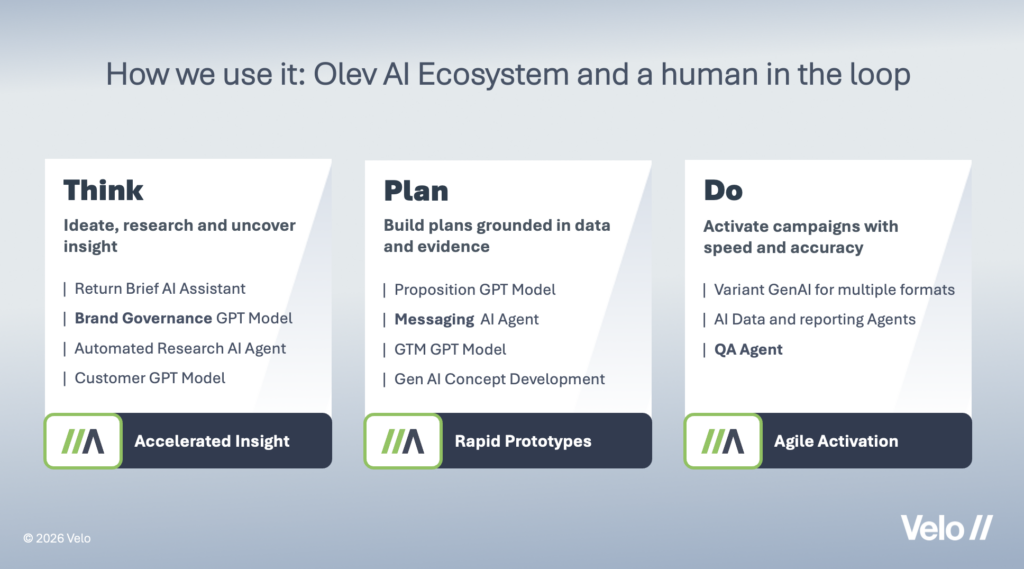
Think, Plan, Do: How we put the ecosystem to work
We apply these tools across three distinct patterns of work, each building on the last.
Think
The thinking stage is about accelerating insight. We use connected tools to speed-up research, surface intelligence and frame opportunities. Automated research agents, governance models and synthetic personas help us reach clarity faster, without sacrificing depth.
Plan
We build data-grounded strategies, propositions and messaging frameworks, then use generative AI and voice-of-customer insight to test and refine ideas before committing. The result is planning that’s evidence-based, not template-driven.
Do
We deploy campaigns faster, generate channel-specific variants and use reporting agents to surface performance insights in real time. A dedicated quality assurance layer maintains brand compliance, tone and governance. In the rush to activate at scale, these are often the first things to slip. Our ecosystem is built to make sure they don’t.
The human in the loop
It would be easy to read all of this and conclude that the agency is simply a configuration layer for a set of AI products. It is not.
The human in the loop is not a checkbox. It is the most vital piece. It is the expertise that orchestrates the different components, provides the judgment that no model replaces, and ensures the ecosystem is pointed at the right problem.
What we have built is a coherent, composable ecosystem that allows us to bring in new technologies as they appear, without rebuilding from scratch.
Working with our clients
We are running sessions with clients, starting from their exact situation, to explore how this approach can support and accelerate their marketing capability. Just reach out to me on Helena.Phillips@velo-b2b.com to arrange this.
Whether that means building parts of the ecosystem into a client’s in-house team, or operating it on their behalf as part of a wrap-around mandate, the aim is the same: to help B2B marketers use tools in the right way, with the right support around them.
The future of B2B marketing is not human or AI. It is human and AI. The agency you choose should know exactly how to bring those together.