


Marketing has a credibility problem. And it’s one of our own making.
Being a senior marketer in B2B has never been harder — or lonelier. Stress levels are high, scrutiny is constant, and the pace of change is relentless. Just keeping current with AI and martech developments demands a level of curiosity and energy that leaves little room to pause and reflect. Staying ahead feels almost impossible when staying level is already a full-time job.
And yet, in the middle of all that pressure, the expectation from the board remains unchanged: show us the revenue.
Ask most marketing directors how their function is performing, and they’ll reach for a familiar set of numbers: website visitors, impressions, click-through rates, social engagement. These metrics are easy to produce, easy to present — and almost entirely unconvincing to a board whose one overriding question is: are we growing revenue reliably?
The uncomfortable truth is that the disconnect between marketing activity and commercial outcomes has cost the profession dearly. When marketers speak in the language of reach and awareness, they lose the room. Boards don’t fund reach. They fund revenue. And when marketing can’t demonstrate its contribution to the pipeline, it cedes that ground to sales.
It’s no coincidence that the Chief Revenue Officer title has become so prevalent in B2B, and that so many CROs come from a sales background. Sales knows how to talk about pipeline, conversion and closed revenue. Marketing, too often, doesn’t. The result is that marketing influence over commercial strategy has shrunk, just at the moment when it should be expanding. This has to change.
A framework for reliable and regular revenue
The scorecard below is designed to give B2B marketers a structured way to measure what actually matters not just activity, but the conditions that lead to sustainable commercial growth.
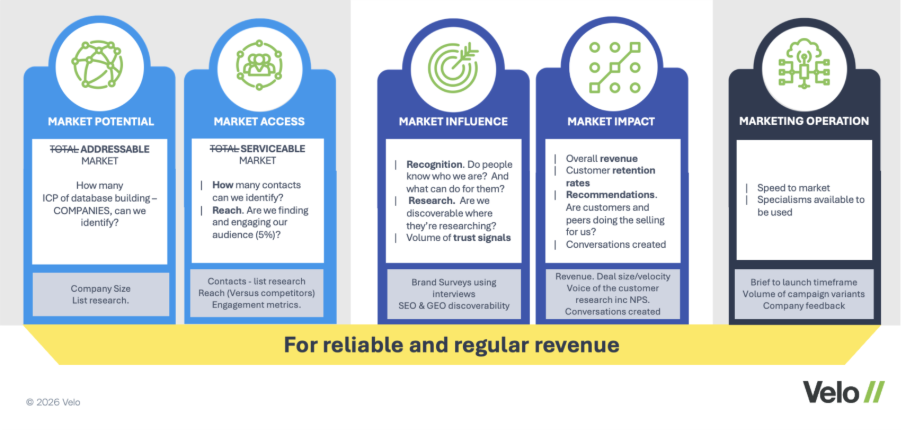
It organises marketing performance across five interconnected areas:
Market Potential asks the most fundamental question: how large is our universe of opportunity? This means identifying the volume of companies that genuinely match your Ideal Customer Profile. The KPI here is simple — CRM counts. If you don’t know how many companies you could sell to, you can’t plan effectively.
- Volume of ICP-matching companies identified
- Company size and segment breakdown
- CRM count of total addressable accounts
Market Access moves from universe to addressable audience. How many of the right contacts can you actually identify and reach? This splits into two measures: the size of your contactable database (CRM counts, persona penetration) and whether your outreach is actually landing tracked through impressions, clicks and interactions.
- Number of contacts with verified contact details in CRM
- Persona penetration rate (coverage across buying committee roles)
- Impressions and reach versus competitors
- Clicks, opens and meaningful interactions (engagement rate)
Market Influence is where marketing’s unique contribution becomes visible. Are people in your market aware of who you are and what you do for them? Are you discoverable when they go looking for a solution? This pillar covers brand recognition, SEO and GEO discoverability versus competitors, and the accumulation of trust signals such as case studies, reviews, analyst mentions, thought leadership – all the factors that build credibility over time. Brand surveys and discoverability benchmarks make this measurable rather than merely felt.
- Brand recognition scores (via regular survey or interview research)
- SEO and GEO discoverability rankings versus key competitors
- Volume and quality of trust signals (case studies, reviews, awards, analyst coverage)
- Share of voice in key channels
Market Impact is the commercial output. Revenue and retention rates are the headline numbers, but this pillar also captures whether customers and peers are actively recommending you doing some of the selling on your behalf. NPS, CSAT, voice of customer research and conversation counts all contribute here. This is where marketing demonstrates its direct line to the numbers the board cares about.
- Overall revenue and deal velocity
- Customer retention and repeat purchase rate
- NPS and CSAT scores
- Volume of inbound conversations and referrals created
- Voice of customer feedback themes
Marketing Operation is the engine behind everything else. How quickly can you take a brief from concept to activation? What specialisms and capabilities — including AI — do you have available to deploy?
These operational metrics matter because speed and capability determine whether the strategy above actually gets executed.
- Brief to activation timeframe (speed to market)
- Number of active campaign variants in market
- Capability and specialism coverage (skills matrix)
- Number of active AI models in use
The conversation that needs to happen
Taken together, this framework gives marketing leaders something they rarely have: a coherent, commercially grounded story to tell at board level.
It starts with market size and works through to revenue — covering awareness, access, influence and impact along the way. Each pillar has clear metrics and KPIs. Each one connects to the next. And the whole thing points toward the only outcome that earns marketing a seat at the strategic table: reliable and regular revenue.
The tools to measure this exist. The data is largely already available. What’s been missing is the framework to organise it and the confidence to present it in terms the board will recognise. That’s what this scorecard is for.