


LinkedIn has quietly added a button that lets users flag posts that “seem like AI slop.” The obvious question is whether clicking it actually does anything. I needed to take a closer look at what LinkedIn’s new flag really does, and what it means for AI-assisted content. Turns out that the answer isn’t to put ChatGPT or Claude back in its box.
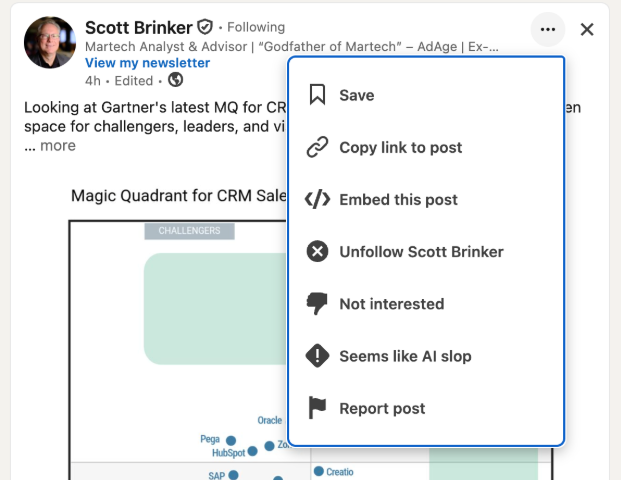
There’s a new option buried in the three-dot menu on LinkedIn posts: “Seems like AI slop.” It took me a while to find it, and once I had, the obvious question was what actually happens when you press it. Does the post’s reach get cut immediately? Is there some kind of review process behind it? Or is it more of a soft signal that feeds into something bigger?
The short answer is the latter. But the button tells us something useful about where LinkedIn thinks content is heading, and where B2B marketers probably need to head too.
First, LinkedIn isn’t banning AI
This is the important distinction. LinkedIn isn’t saying AI-generated or AI-assisted content is automatically bad. Its Chief Product Officer, Hari Srinivasan, has been fairly explicit that AI and “slop” aren’t the same thing.
LinkedIn accepts that people use AI to refine their thinking, improve their language and get more comfortable publishing, and that’s a reasonable position. AI is genuinely useful for research, structure, first drafts, editing, repurposing and shortening content, or simply for getting started when you’re staring at a blank page.
The issue was never whether ChatGPT touched the copy. It’s whether anybody had anything worth saying in the first place.
LinkedIn’s attention seems to be on content that’s polished and technically competent but generic, repetitive, or lacking any real point of view. It’s investing in classifiers built to identify both “AI slop” and low-quality content more broadly, particularly when it decides what to recommend outside someone’s existing network. We all know the type of post this catches: the “AI isn’t replacing marketers, marketers using AI are replacing marketers who aren’t” line, the “here are 17 things I learned before breakfast” post, and everything in that family.
What happens when you click it?
Right now, the button behaves more like a feedback signal than a formal content report. LinkedIn says member feedback helps tune the models it uses to identify low-quality content, and it’s also testing ways to privately tell creators, through their analytics, when other members feel their content came across as inauthentic or overly reliant on AI. One person clicking the button doesn’t appear to tank anyone’s reach on its own.
The more interesting effect is cumulative. LinkedIn is essentially asking its users to help teach it what “slop” looks like, and those signals then feed into the systems that decide which content gets wider distribution. The button itself isn’t really the story. The direction of travel is.
What does that means for B2B marketers?
Not “stop using ChatGPT.” If anything, the opposite. Used properly, AI makes us faster: it helps us interrogate information, explore structures, summarise research, repurpose thinking and refine language. But it comes back to one of our more blunt internal principles: shit in, shit out.
Ask AI to “write me a LinkedIn post about AI in manufacturing” and you’ll get something perfectly serviceable. That’s the problem. It’ll be serviceable for almost anyone in almost any sector, because there’s nothing in the prompt that couldn’t apply to any company in the room.
Give AI an interview with a subject matter expert instead, or an observation from a customer conversation, some campaign data, a genuine disagreement with received wisdom, or a specific question prospects keep asking, and you get something different: source material, evidence, a point of view. That’s when AI has something worth working with.
My rule: AI can help write the content. It shouldn’t be responsible for having the idea.
The five-second AI slop test
Before an AI-assisted LinkedIn post goes live, it’s worth running through a few questions:
- Could this have been written for almost any company or person?
- Is there a genuine opinion, insight, example or piece of evidence in it?
- Does it actually sound like the person or company supposedly saying it?
- Will the intended audience learn anything from reading it?
- Are we using AI to improve an idea, or because we didn’t really have one?
None of those are really tests for AI. They’re tests for good content.
This makes proper thought leadership more valuable, not less
For employee advocacy and executive ghostwriting especially, LinkedIn’s move strengthens the case for capturing the thinking before writing the post. That doesn’t have to mean booking another 60-minute interview nobody has time for. It could be a voice note, a Teams message, a reply to a customer question, a quick reaction to industry news, a comment left in Pulse, or an unfiltered email fired off straight after a meeting. Capture the human part first, then use AI, a writer, or ideally both, to shape it without sanding away whatever made it sound like an actual person.
LinkedIn itself appears to be heading the same way. It’s removing its AI-powered “enhance your post” feature and replacing it with proofreading designed to improve someone’s words without changing their voice. That’s a meaningful shift. The opportunity for AI isn’t necessarily to become the author. It’s to become a genuinely useful editor.
And don’t forget the comments
The same principle applies below the post. LinkedIn is tackling automated comments too, and says it already catches hundreds of thousands of automated comment attempts a day, which will be welcome news to anyone who has shared a considered opinion only to get “Great insight! Completely agree. Thanks for sharing.” in return. Ten thoughtful comments from people with something useful to add have always been worth more than a hundred pieces of synthetic applause. Now there’s an algorithmic reason for that, alongside the human one.
What about paid LinkedIn?
For now, LinkedIn’s announcement is focused on member posts, comments, suggested content and feed quality, and I haven’t seen anything confirming that an “AI slop” signal directly changes ad quality, CPM, CPC or advertiser standing. The grey area worth watching is boosted organic content and Thought Leader Ads, where the line between organic and paid distribution is naturally blurrier. That’s one to keep an eye on rather than draw conclusions about yet.
Less slop, more substance
So does LinkedIn’s “Seems like AI slop” button actually do anything? Yes, just not in the dramatic way the name suggests. It’s a mechanism for LinkedIn to understand what users perceive as low-quality or inauthentic content, and to use that feedback to improve how the feed works. It sits alongside classifiers, anti-automation measures and changes to LinkedIn’s own AI writing tools.
The takeaway for B2B marketers isn’t that AI has suddenly become dangerous. It’s that generic has, which is probably a healthy development. Brands and people with real experience, proper evidence and something worth saying now have an even stronger reason to put those things at the centre of their content. AI can still help us get there. We just need a human deciding where we’re going.