

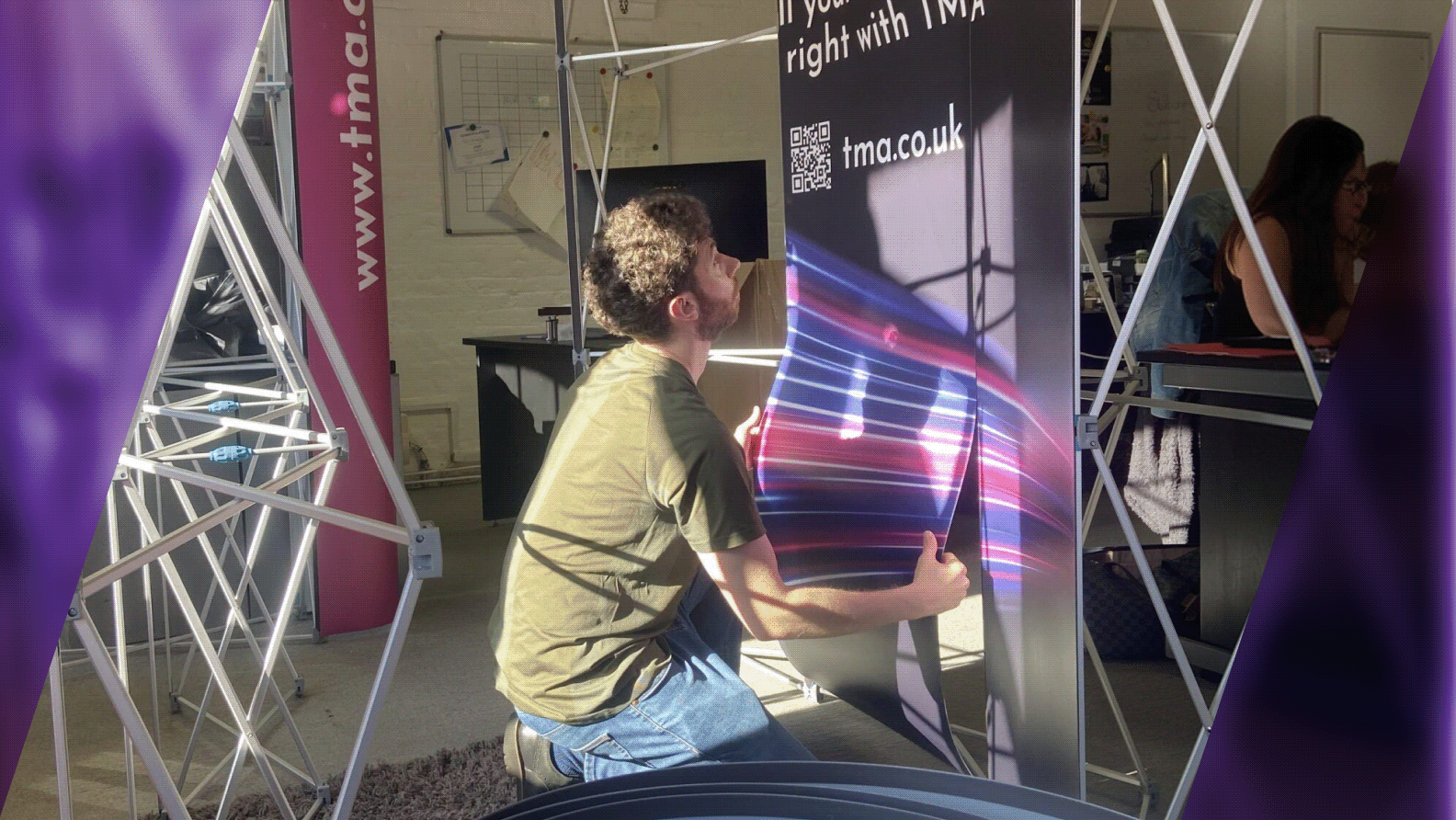
There’s a lot that goes into a successful B2B event. Unfortunately, quite a lot of it also needs to fit into someone’s car.
Typically, our clients spend around 40% of annual marketing budgets on events, and with good reason. Getting access to the community of buyers is vital, and often difficult. That’s where niche, sector-specific events are unmatched. For those niche B2B brands often hidden in plain sight, bringing together audiences around a subject area highlights their relevance, use cases and importance in a way that few other marketing channels can.
Stand design/build, sponsorship packages, promotional items, brochures, travel and hotels all get a purchase order and a line on the spreadsheet. Moving your kit to and from each show rarely gets either, often being left to whoever happens to have the biggest boot. Getting stands, banners, screens and brochures to the venue, then storing them safely until the next one, usually costs teams more than they realise, mainly because kit gets damaged, lost or even binned when, with some care, it could be reused.
That cost has always existed. It matters more now, for two reasons. AI is taking over more of the B2B buying journey, which leaves events as one of the few moments buyers still meet suppliers face to face. At the same time, teams are moving their spend into more frequent, smaller events, so every pound of event budget must work harder. Events are more important than ever before.
AI is cutting the moments buyers spend with people
Forrester’s State of Business Buying 2026 report describes generative AI search as the new starting point for B2B buyers. Gartner’s figures show what follows. In a survey of 645 B2B buyers published in May 2026, 45% had used generative AI during a recent purchase, mostly to research vendors and products. In a separate Gartner release from March 2026, 67% of buyers said they would prefer a buying experience with no sales rep at all.
Not particularly encouraging news if your job involves selling things to people.
That leaves sellers with less time and fewer ways to reach buyers. A large share of the research, shortlisting and comparison that used to involve a phone call, a demo or a lunch now happens in a chat window, before your sales team knows the buyer exists.
Buyers still want to talk to people, but they want those conversations later in the process, and they expect more from them. In the same Gartner survey, 51% of buyers said they were more likely to come across misleading information from generative AI, and 69% wanted to check AI-generated insights with a sales rep. So, rather ironically, AI is also giving buyers another reason to speak to an actual human being. Events give them the opportunity to do this.
Events are a vital part of the marketing plan
Marketing teams have noticed. Forrester’s Q1 2026 State of B2B Events survey of more than 400 event decision-makers found that most organisations plan to run more in-person events with fewer than 200 attendees, and two-thirds plan more workshops, roundtables and structured networking sessions. Only 18% plan more large hosted events, and nearly 70% are cutting the total number of events they run.
The calendar is moving away from one or two flagship shows towards a steady run of smaller, targeted sessions: a stand at ExCeL in spring, a roundtable at a private venue in June, a customer dinner in September and a regional seminar in Birmingham in October. Each event is smaller, but the kit moves more often. All perfectly sensible, until you remember that the same collection of banners, brochures and branded tablecloths needs to make an appearance at every single one.
Budgets haven’t moved to match. Forrester’s 2026 survey found that two-thirds of organisations still face flat or falling event budgets. A flat budget covers less every year, and it doesn’t include space for replacing kit. The result? Higher expectations, less money and an exhibition stand that’s seen more of the M25 than most sales directors.
Where the money goes
Logistics costs rarely show up as one figure, which is why they go unnoticed. That would make them far too easy to spot. They usually sit in five places.
- Storage. Kit lives in a corner of the office, a self-storage unit, or a supplier’s warehouse. Occasionally, it becomes a permanent feature of an employee’s garage, much to the delight of everyone in their household. Each option costs money, floor space or goodwill, and many teams use more than one.
- Transport. Van hire, couriers, fuel, congestion charges, venue parking and loading-bay fees. They go through expenses or operations budgets, a few hundred pounds each time. Every extra event on the calendar adds another trip there and back. And that’s before somebody discovers the stand doesn’t actually fit in the car they’ve booked.
- Damage and replacement. Graphics crease, frames bend, screens crack and parts go missing between shows. Sooner or later someone reprints a banner or orders a new stand, and the business pays again for something it already owned. Teams tend to record this as “refreshing the stand”, even when the real cause was poor storage.
- Staff time. This is usually the biggest cost and the least visible. It’s difficult to focus on your event strategy when you’re filling out loading bay forms and figuring out how to squeeze a two-metre banner stand into a hatchback. The person loading the car the day before a show is often the person who should be confirming meetings, briefing sales and working through the attendee list. With a buying group of 22 people, that preparation decides which conversations you have on the day.
- Lost follow-up. When the show ends at 5pm, your team often spends the evening breaking down the stand and driving it back to storage (usually after spending twenty minutes trying to locate the missing extension cable). Leads stay in the badge scanner until later in the week. Buyers now rely on very few personal conversations to check what AI has told them, so a two-day delay in following up can cost you the one conversation the event was meant to produce.
What this means for event strategy
Teams that get the most from events treat logistics as something to sort out once, so the staff they send spend their time on buyers, preparation and same-day follow-up.
In practice that means a single safe home for kit near the venues you use most, one reliable way of getting it there and back, and a team whose job at the event is to talk to buyers. Not assembling furniture, hunting for extension cables or working out whose car everything is going home in.
It’s not particularly glamorous, but a little organisation behind the scenes means less money wasted, fewer logistical headaches and, ideally, a marketing team that actually gets to spend its time doing marketing.
It will be an investment you appreciate.
Velo runs The Marketing Cupboard, an insured storage and event logistics service in London SE1 for B2B marketing teams. Find out more.